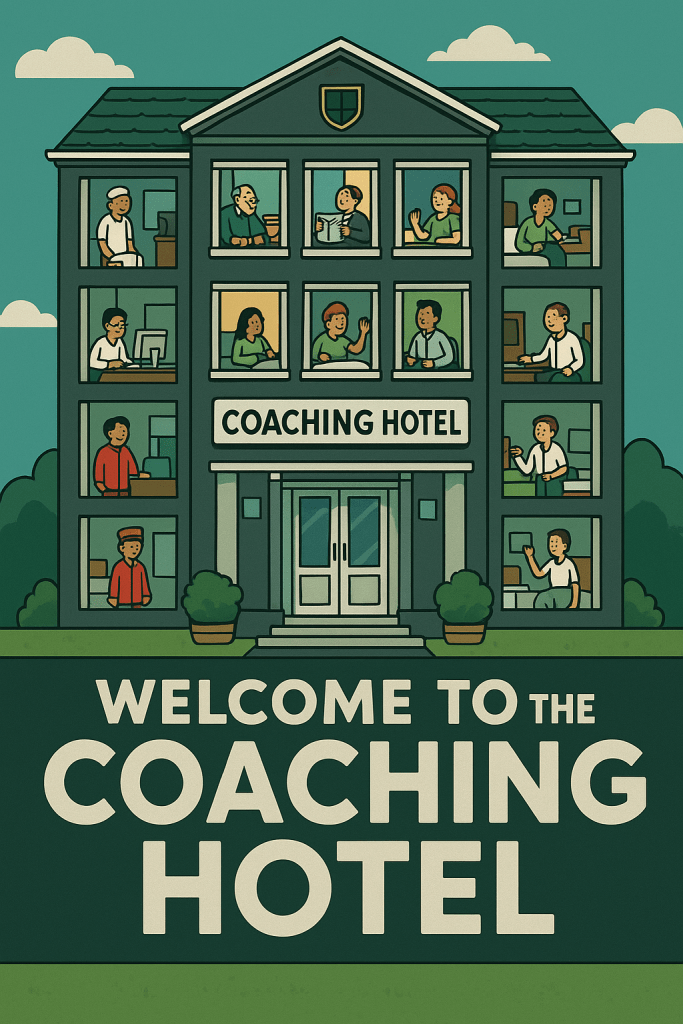
Your coaching conversation takes place inside a hotel. Although this hotel does not yet exist.
Your conversation starts in the metophorical reception area, you are greeted by the considerate member of the team, supporting initial introductions, signing agreements and discussing the ground rules of your stay. Once the foundations are set you are invited into the main lobby.
Within this lobby you are provided with a choice to view long corridors and multiples rooms, IF that’s how you have designed your establishment. Every guest, doorway, and room represents a meaningful element of the dialogue. Just as a hotel welcomes visitors from all walks of life, the coaching space welcomes the many influences, assumptions, emotions, and perspectives that accompany the coachee. Rather than treating these as distractions, the coach acknowledges them as legitimate “visitors” whose presence shapes the conversation.
These visitors arrive with different levels of importance, impact, or “class.” Some may be long-standing companions—deep-rooted beliefs, personal values, or established relationships. Others may be transient travellers—fleeting thoughts, external pressures, or momentary concerns. Each one has a distinct relationship with the coachee, and part of the coach’s role is to help identify who these visitors are, why they are there, and what role they are playing in the coachee’s experience. Some stay go a few hours, some stay for months, some even have such a role within the hotel that they could be seen as staff. Who is cleaning up? Who is supporting the functions of the hotel?
By recognising the full cast of characters within the hotel, the conversation becomes richer and more grounded in reality.
Every door in this metaphorical hotel leads to a different room, each representing a potential direction for exploration. One room may house past experiences; another may contain the coachee’s current challenges; yet another may reveal aspirations, fears, or untapped strengths. Opening a particular door invites the coachee to step into that space, examine what they find, and decide what to bring back into the broader discussion. I wonder who joins us in each room, do we keep people out or invite others to share the room’s experience. The coach helps the coachee choose which doors to open—sometimes gently guiding, sometimes simply illuminating the options.
Ultimately, the power of this hotel metaphor lies in its ability to bring order, curiosity, and meaning to the coaching process. By attending to visitors, rooms, and pathways, the coach and coachee co-create a landscape where understanding deepens and insights emerge. Everything inside the hotel—the guests, the layout, the open and unopened doors—matters. The absence of individuals may also support valuable discussion as to why do they not have a hotel pass. Each element contributes to a coaching conversation that is intentional, contextual, and uniquely tailored to the person at its centre.
Who is in your Hotel? Do you have enough rooms? How can we keep the hotel running smoothly?
I will leave it here for now, more coming soon on how to apply this whilst maintaining safety and clarity on the hotels value.
Luke
 Luke Webb Coaching